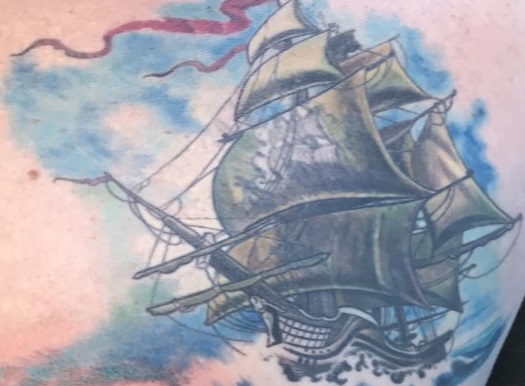
For almost 30 years, I had this tattoo on my back. It's on my right shoulder blade. It was a dark ship (faded to blue) under full sail crashing through a blue wave. If I haven't shown you, it's probably because for 25 years I believed it was the wrong tattoo.
In college, my favorite professor's favorite book was Moby Dick. It became my favorite book. A Missouri kid who had never left the Midwest, I was caught up in the adventure of it, the years' long voyage, the isolation of the crew, the madness of their captain. Enough themes are lashed and rigged to its deck to sustain most readers--certainly me--around the world.
But I was also drawn to Melville's love and awe of whales. When John Gilgun taught the book, he wanted us to immerse ourselves in whales and whaling. We listened to recordings of whale song, we looked at photos of scrimshaw, one Spring day, he had the class line up on the quad in a line that stretched the length of an adult sperm whale.
In the first few years after John recruited me to the book, I read that novel every year. Sometimes I came back to read favorite chapters in between full readings. It had something new each time and it was a joy to stumble across favorite lines or favorite scenes. The first time they lower boats to chase whales is as exciting as anything I have ever read.
I graduated from college in the summer that we found out that Tabitha was pregnant and that I had been accepted to grad school...in the summer that we moved to California so we could have health insurance to cover the delivery, then back to Ohio so I could start at Bowling Green...in the summer that we asked my brother, Brian, and our friend Wendy to come along on the roadtrip to California.
It was the same summer they drowned together...just a week after they got back from our roadtrip.
I loved my brother deeply. He admired me in the way that only a little brother can--no one will ever feel that way about me again. But, in the days leading up to his death, we were feuding. He and Wendy were having an affair. She was married to another close friend and I was furious with both of them. I had never heard of the Internet. He didn't have a phone. So I poured out my anger and accusations in letters to him.
I remember finding those letters on his coffee table when I flew back to Missouri to claim the body.
We had never fought before. We squabbled and bickered over minor things, but I told him in those letters that I was ashamed of him. Those were the last things I ever said to him.
So my grief, tangled in remorse, sunk to rage. When I turned to Moby Dick that fall, I read it in a very different way. Ahab was a hero. Ahab had the right idea. God was an asshole--unfit to run a Dairy Queen, much less creation. I understood Ahab's wound, his fury, and his craving for vengeance.
Speak not to me of blasphemy, man; I'd strike the sun if it insulted me. Look ye, Starbuck, all visible objects are but as pasteboard masks. Some inscrutable yet reasoning thing puts forth the molding of their features. The white whale tasks me; he heaps me. Yet he is but a mask. 'Tis the thing behind the mask I chiefly hate; the malignant thing that has plagued mankind since time began; the thing that maws and mutilates our race, not killing us outright but letting us live on, with half a heart and half a lung.
So I decided to get a tattoo of the Pequod--the white ship in which Ahab and his doomed crew chased the white whale. There was vanity mixed into my grief, so I thought about where the tattoo would look most striking and (for some reason that made sense at the time) I decided to get it on my right shoulder blade.
The tattoo artist was young. He might have been high. Or maybe I just didn't stress enough that I wanted a white ship. I didn't get it. When I finally stood up and looked in the mirror, there was a brown three-masted sailing ship. Not the Pequod. Not even a particularly good ship.
That just added to the rage.
As the years passed, I would sometimes mention the tattoo to friends. I even showed it to a few people. But as soon as they asked for the story, I knew that anyone who had read the book would know that this was the wrong tattoo.
After a few years, I just stopped mentioning it at all.
Three years ago, I was teaching a class on oral storytelling in our Ascent program. It's a program designed to give new college students who might otherwise struggle with the transition to college, a head start. One goal is to help them form community. So I came up with a story prompt called "So I have this tattoo" that was supposed to get them to share a meaningful event or experience and to use descriptive language to paint a picture.
The night before I was to introduce the prompt, I started thinking about what I would say about my tattoo. All the familiar recriminations came to mind. I struggled to articulate how badly I had botched this. In part, because I had the memory of the anger, but not the actual taste of anger in my mouth.
I thought about the old rage and realized I wasn't on Team Ahab any more. And then I remembered the Rachel. Towards the end of the book (chapter 941, I think). Another ship approaches the Pequod as they are hunting Moby Dick. Ahab shouts to the other captain, asking if they have seen the white whale. "Yes!" says the other captain. "He was headed that way yesterday! But look, my sons were in another whale boat and they fastened to a whale that pulled them in the other direction. We've been searching but haven't seen them. If our two ships can execute a search grid..."
"Yeah, yeah, yeah," says Ahab. "About the white whale, which way was it headed?"
And so Ahab told the other captain to go fly a kite and went off after Moby Dick.
And found him.
And was killed by him.
And Ahab's ship and all its crew were also destroyed by him.
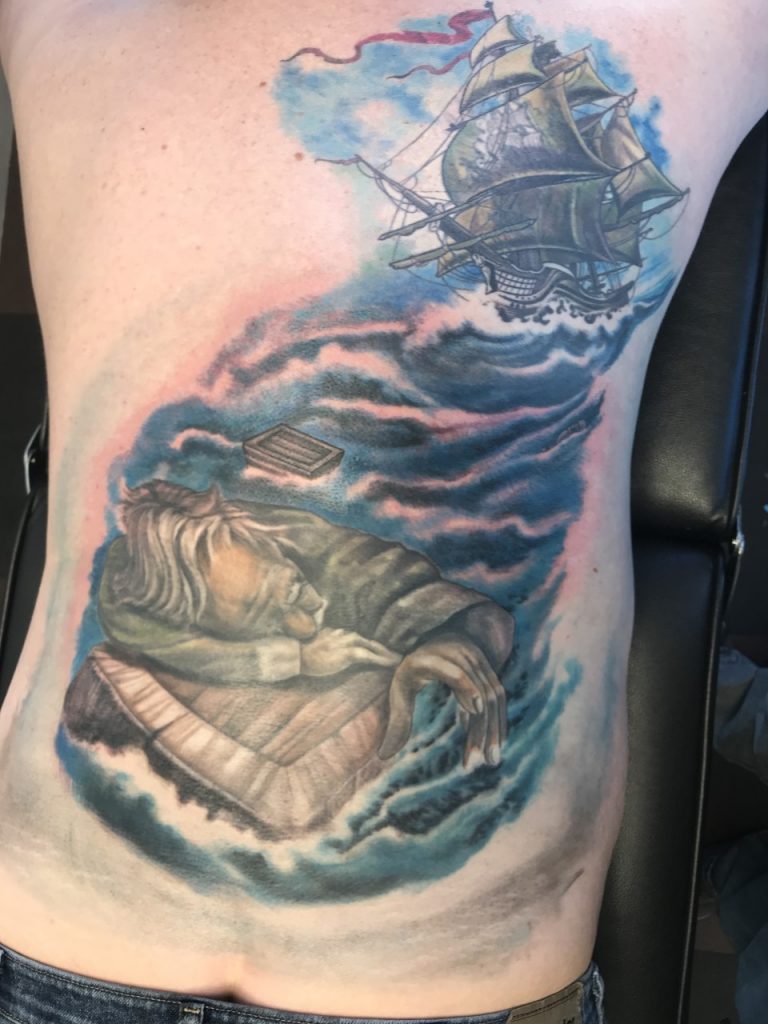
Except the narrator, Ishmael, who floated out of the wreck on a coffin, all alone at sea.
On the second day, a sail drew near, nearer, and picked me up at last. It was the devious-cruising Rachel, that in her retracing search after her missing children, only found another orphan."
It had been 25 years since I had gotten that ship tattooed on my back and it was only in the act of explaining it to these kids that I realized it wasn't the wrong ship. It wasn't the Pequod. Whether it was fair or not, she drowned.
My rage has dried up.
My tattoo was of the Rachel. She is crewed by all of the people in all of these years who--desperately looking out across the vast expanse of their own pain--nevertheless noticed me. And saved me.
Thank you, shipmates. Thank you.
And the story has an epilogue. After more than a year (due to the pandemic), today I got the last sting of the new tattoo. It's much larger. It has Ishmael, floating on that coffin, about to be rescued by the Rachel. We wrapped it up the day after I learned that John Gilgun, who ignited my love of Moby Dick has died. He and I were great friends in the years after Brian and Wendy's death. I know he was one of those in the bow, searching.